If you’re a healthcare dispenser—whether you run a pharmacy, clinic, hospital, or any facility that handles prescription drugs—you’ve likely heard about DSCSA compliance. You might even think you’re already compliant because your distributor sends you product information via email or PDF. But here’s the critical truth: by November 2026, having the data isn’t enough. The FDA is raising the bar, and understanding the difference between “electronic” and “interoperable” could mean the difference between operating legally and facing serious regulatory consequences.
The Electronic vs. Interoperable Distinction
Under the Drug Supply Chain Security Act (DSCSA), there’s a crucial legal distinction that many dispensers misunderstand. While an email attachment or PDF containing product information is technically “digital,” the FDA classifies it as “human-readable” only. This means a person must manually open the file, read through the information, and verify the data by hand.
For 2026 compliance, the law requires something fundamentally different: an interoperable system that is “machine-readable.” This isn’t just regulatory semantics—it’s a complete paradigm shift in how pharmaceutical supply chain data must be handled.
An interoperable system exchanges data using a standardized file format called EPCIS (Electronic Product Code Information Services). This standardization allows your distributor’s computer system to communicate directly with your facility’s database without human intervention. Instead of manually checking serial numbers from an email, an interoperable system automatically captures those unique identifiers and creates a secure, searchable record that ensures every product is verified and traceable without the risk of human error.
Think of it this way: the difference between a PDF and an interoperable system is like the difference between receiving a handwritten letter and having a direct bank transfer. Both convey information, but only one creates an automated, verifiable, and instantly accessible record.
The 2026 Add-Ons: ATP and VRS
Beyond interoperability, the November 2026 deadline introduces two critical “safety checks” that fundamentally change how you must verify your pharmaceutical supply chain. These aren’t optional features—they’re legal requirements that protect both your patients and your organization.
Authorized Trading Partner (ATP) Verification
Federal law explicitly prohibits dispensers from purchasing prescription drugs from anyone who isn’t an “Authorized Trading Partner.” This isn’t a new concept, but enforcement is becoming significantly more rigorous in 2026.
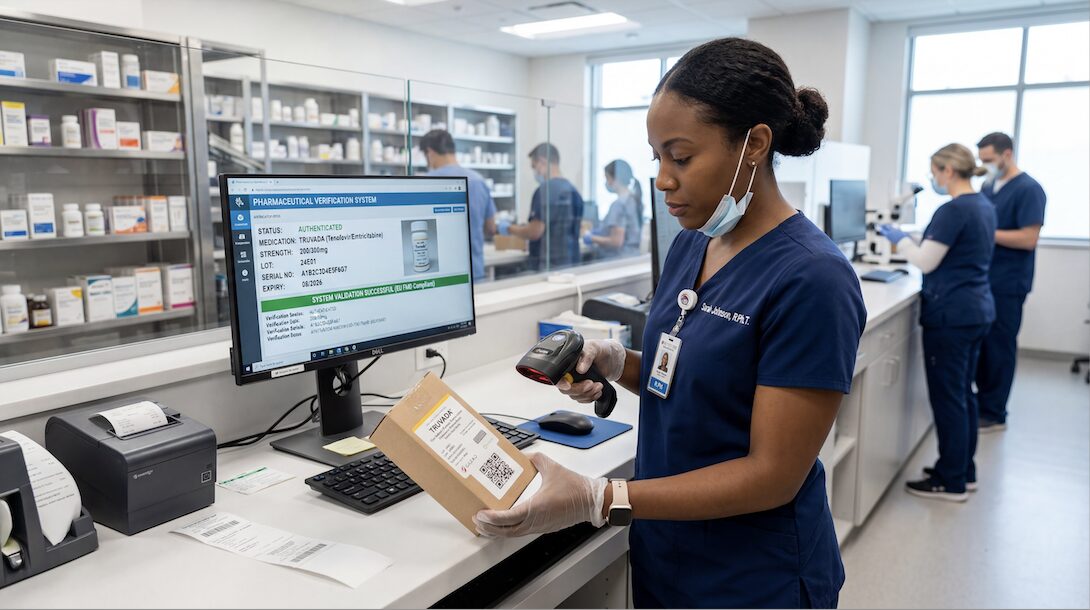
An interoperable system automatically verifies that your supplier maintains a valid, up-to-date license. This happens in real-time, before products even arrive at your door. If a supplier’s license expires or is revoked, a compliant system will flag the shipment as “unauthorized” immediately. You won’t accidentally accept products from an unlicensed source because you forgot to check their credentials manually.
This automated verification protects you from liability. In the event of a supply chain investigation, you’ll have timestamped, digital proof that you performed due diligence on every single transaction.
Verification Router Service (VRS)
Counterfeit pharmaceuticals represent a serious threat to patient safety and organizational integrity. If you ever suspect a product might be counterfeit—perhaps the label looks unusual, the seal appears tampered with, or the packaging seems off—you are legally required to perform a verification.
This is where the Verification Router Service becomes essential. A VRS creates a “digital handshake” between your system and the manufacturer’s database in real-time. When you scan a suspect product’s serial number, the VRS instantly checks whether that specific unit was actually produced by the legitimate manufacturer and whether it’s currently flagged as stolen, recalled, or otherwise compromised.
You simply cannot perform this verification with an email or PDF. The process requires live, bidirectional communication with authoritative databases. Without a VRS-enabled system, you have no reliable way to verify suspect products, which means you’re operating outside compliance and potentially putting patients at risk.
The Legal Framework: Where These Requirements Come From
For those who want to verify these requirements directly, here are the specific legal citations:
Interoperability Requirement: Section 582(g)(1) of the Federal Food, Drug, and Cosmetic Act mandates electronic, interoperable exchange of transaction information at the package level.
Authorized Trading Partner Requirement: Section 582(d)(1) prohibits dispensers from accepting products from any entity that is not an Authorized Trading Partner.
Verification Requirement: Section 582(d)(4) requires dispensers to have systems in place to verify suspect products at the package level.
These aren’t suggestions or best practices—they’re federal law with enforcement mechanisms that include significant penalties for non-compliance.
What This Means for Your Organization
If you’re currently receiving product information via email, spreadsheet, or PDF, you have the right data today, but you don’t have the right system for tomorrow. After November 2026, compliance requires automation of both the ATP verification and VRS capability.
The transition to an interoperable system isn’t just about avoiding penalties. It’s about building a more efficient, secure, and defensible supply chain. Manual verification is time-consuming, error-prone, and creates liability. An interoperable system handles these verifications automatically, creating an audit trail that protects your organization while freeing your staff to focus on patient care rather than paperwork.
Taking Action Before the Deadline
The November 2026 deadline may seem distant, but implementing an interoperable system isn’t something you can accomplish overnight. You’ll need to evaluate solutions, integrate them with your existing workflows, train your staff, and establish new protocols with your suppliers.
Start by assessing your current state. Ask yourself:
-
How do we currently receive transaction information from our suppliers?
-
Can our system automatically verify that suppliers are Authorized Trading Partners?
-
Do we have the capability to perform real-time verification of suspect products?
-
Can we produce a complete, serialized audit trail for every product we dispense?
If you answered “no” to any of these questions, you have work to do before November 2026.
The Bottom Line
DSCSA compliance in 2026 isn’t about having data—it’s about having the right system to automatically verify, track, and authenticate every pharmaceutical product that enters your facility. The distinction between “electronic” and “interoperable” isn’t technical jargon; it’s the difference between compliance and violation.
Your patients trust you with their safety. Federal law requires you to verify that trust extends throughout your entire supply chain. An interoperable system with ATP and VRS capabilities isn’t just a regulatory checkbox—it’s the foundation of that verification.
The time to prepare is now. Don’t wait until the deadline is looming to discover that your current process leaves you exposed. Invest in the right technology, partner with compliant suppliers, and build a supply chain that’s not just legal, but truly secure.
For more information about DSCSA compliance solutions designed for healthcare dispensers, visit TrackTraceRx to learn how interoperable systems can protect your organization and your patients.