A Technical Guide for Pharmaceutical Manufacturers Navigating DSCSA Enhanced Requirements and the 12-Digit NDC Transition
The pharmaceutical supply chain has reached a critical inflection point. As of November 2024, the Drug Supply Chain Security Act (DSCSA) enhanced drug distribution security requirements are now in full enforcement—with phased exemptions ending for most trading partners by late 2025. Simultaneously, the FDA is transitioning from the legacy 10-digit National Drug Code (NDC) format to a standardized 12-digit format, fundamentally altering how manufacturers must construct Global Trade Item Numbers (GTINs) for serialization and traceability.
This guide provides pharmaceutical manufacturers with a comprehensive, step-by-step framework for assigning GTINs to NDCs in compliance with current regulations. Unlike the pre-2024 landscape where the 10-digit NDC could be directly embedded within a GTIN-14 structure, the new 12-digit NDC exceeds the available digit capacity within traditional GTIN construction methods. This technical reality requires manufacturers to adopt new interoperability models that maintain the critical association between NDC and GTIN while ensuring full compliance with GS1 standards and DSCSA electronic traceability mandates.
Understanding the Regulatory Landscape: DSCSA Enhanced Requirements
What Changed in 2024-2025
The DSCSA implementation timeline reached its culmination in late 2024, marking the end of a decade-long phase-in period. The enhanced drug distribution security requirements under section 582(g)(1) of the FD&C Act mandate that all trading partners in the pharmaceutical supply chain—manufacturers, repackagers, wholesale distributors, and dispensers—implement electronic, interoperable systems for package-level tracing.
The FDA adopted a phased compliance approach following the expiration of the one-year stabilization period. The manufacturer exemption expired in early 2024, while the wholesale drug distributor exemption ended on August 27, 2025. Small dispensers received extended exemptions until November 27, 2026, acknowledging the significant technical and financial burden of implementing EPCIS-compliant systems.
The Four Pillars of DSCSA Compliance
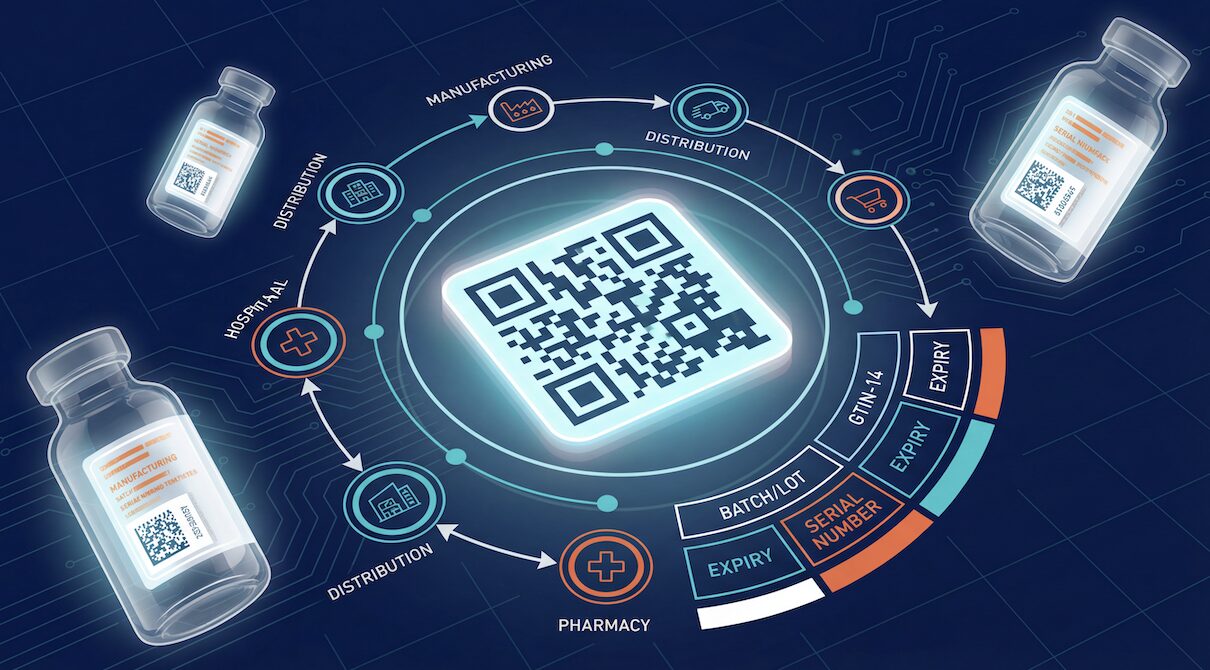
Every serialized prescription drug package entering the U. S. supply chain must now carry a GS1 DataMatrix 2D barcode containing four critical data elements encoded in GS1 Application Identifier format:
-
GTIN (AI 01) – The 14-digit Global Trade Item Number that uniquely identifies the product and packaging level
-
Serial Number (AI 21) – A unique alphanumeric string assigned to each individual package
-
Lot Number (AI 10) – The manufacturing batch identifier
-
Expiration Date (AI 17) – The product expiry date in YYMMDD format
Beyond the physical barcode, manufacturers must now transmit electronic transaction information using EPCIS (Electronic Product Code Information Services) format. This represents a fundamental shift from paper-based or PDF transaction statements to structured, machine-readable data that can be verified and traced in real-time throughout the supply chain. The interoperability requirement means that disparate systems across manufacturers, distributors, and dispensers must be able to exchange and validate serialization data seamlessly.
Enforcement Reality in 2026
While the regulatory deadlines have passed, the practical reality of enforcement continues to evolve. FDA officials have made clear that no further blanket delays will be granted beyond the existing exemptions for small dispensers. However, the agency has acknowledged ongoing challenges with data exchange rates—some large retail pharmacies and health systems report receiving less than 50% of expected EPCIS data files, with some experiencing rates as low as 20-30%.
For manufacturers, this means that GTIN assignment and serialization infrastructure must be fully operational now. Any new products entering the market, any packaging changes, or any modifications to existing product lines must incorporate compliant GTIN structures and serialization from day one. The window for remediation has closed.
The 12-Digit NDC Transition: Technical Implications
Why the FDA Is Expanding the NDC Format
The FDA’s decision to transition to a standardized 12-digit NDC format stems from a straightforward capacity problem: the agency is running out of available labeler codes under the legacy 10-digit system. The new format will be implemented over a five-to-six-year timeline, creating a transitional period where both 10-digit and 12-digit NDCs will coexist in the supply chain.
The proposed 12-digit format maintains the three-segment structure but with standardized lengths:
-
Labeler Code: 6 digits (expanded from the variable 4-5-6 digit structure)
-
Product Code: 4 digits (standardized from the variable 3-4 digit structure)
-
Package Code: 2 digits (standardized from the variable 1-2 digit structure)
This “6-4-2” configuration eliminates the ambiguity that plagued the legacy system, where the same sequence of digits could represent different products depending on segment boundaries. For example, under the old system, 1234-5678-90, 12345-678-90, and 12345-6789-0 could all be entirely different products despite sharing the same numeric sequence.
The GTIN-14 Capacity Problem
The technical challenge emerges when attempting to embed a 12-digit NDC within a GTIN-14 structure. The anatomy of a GTIN-14 consists of:
-
Indicator Digit (1 digit) – Identifies packaging hierarchy level
-
GS1 Company Prefix (variable length, typically 7-10 digits)
-
Item Reference (variable length, fills remaining space)
-
Check Digit (1 digit) – Calculated using the GS1 algorithm
Under the legacy system with 10-digit NDCs, manufacturers could construct a GTIN-14 using the format: [Indicator][03][10-digit NDC][Check], where “03” represents the GS1 US Company Prefix for pharmaceutical products. This yielded a structure like: 0-03-11111-0001-1-x, where the 10-digit NDC (11111-0001-1) fit neatly within the 14-digit framework.
With a 12-digit NDC, this direct embedding approach fails mathematically. The structure [1 digit][03][12-digit NDC][1 digit] requires 17 positions—three more than the GTIN-14 format allows. This is not a minor technical inconvenience; it represents a fundamental incompatibility between the regulatory identifier (NDC) and the supply chain identifier (GTIN).
The New Paradigm: Association Rather Than Embedding
The industry consensus emerging from GS1 US and FDA guidance is clear: the new 12-digit NDC format amplifies the need to associate an NDC with a GTIN rather than embed it directly. While the NDC can no longer be embedded in the product GTIN using the legacy method, the association between GTIN and NDC remains critical for regulatory compliance, reimbursement, and supply chain operations.
This shift requires manufacturers to maintain robust master data management systems that link each GTIN to its corresponding NDC through external databases rather than relying on the GTIN structure itself to carry the NDC information. The GTIN becomes a pure supply chain identifier, while the NDC remains the regulatory identifier, with the two connected through data architecture rather than numeric embedding.
Understanding the Indicator Digit: Packaging Hierarchy Fundamentals
Before diving into GTIN construction, manufacturers must understand how the Indicator Digit defines packaging hierarchy—a concept that becomes even more critical as the industry moves away from NDC-based grouping identification.
The Role of the Indicator Digit
The Indicator Digit is the first digit of a GTIN-14 and serves a single, specific purpose: to differentiate various packaging levels of the same product within the supply chain. It does not change the fundamental product identity; rather, it signals to trading partners what type of packaging configuration they are handling.
Indicator Digit Values and Their Meanings:
-
0 = Individual Saleable Unit (the “each” that a pharmacy dispenses or sells to a patient)
-
1-8 = Groupings or aggregations of saleable units (cases, bundles, pallets, shipper configurations)
-
9 = Reserved for variable-measure products (not used in pharmaceutical applications)
GS1 intentionally does not prescribe which specific grouping type corresponds to which Indicator Digit value (1 through 8). This flexibility allows manufacturers to define their own packaging hierarchy based on their distribution models. However, once a manufacturer assigns an Indicator Digit to a specific grouping type for a product, that assignment should remain consistent to avoid supply chain confusion.
Typical Pharmaceutical Packaging Hierarchy
Most pharmaceutical manufacturers adopt a three-tier hierarchy:
-
Saleable Unit (Indicator 0): The bottle, blister pack, vial, or other primary package that will be dispensed to the patient. This is the only level that requires an NDC to be registered with the FDA.
-
Case or Shipper (Indicator 1 or 2): A homogeneous collection of saleable units, typically a corrugated case containing 12, 24, 50, or 100 units of the identical saleable package. This is the level most commonly handled by wholesale distributors.
-
Pallet (Indicator 3 or 4): A homogeneous collection of cases, typically shrink-wrapped on a pallet for warehouse storage and transportation. This level is primarily used for manufacturer-to-distributor shipments.
Some manufacturers also define intermediate levels such as bundles (smaller groupings than a full case) or mixed pallets, using additional Indicator Digit values as needed.
Critical Rule: One NDC, Multiple GTINs
A fundamental principle of proper GTIN assignment is that a single NDC (representing a specific drug product in a specific saleable package size) should generate multiple GTINs—one for each packaging level in the hierarchy. The NDC itself only identifies the saleable unit. The GTINs identify the saleable unit and all of its groupings.
Example: A 30-count bottle of a medication
-
NDC: 12345-6789-01 (registered with FDA for the 30-count bottle)
-
GTIN for Saleable Unit: 00312345678901X (Indicator 0)
-
GTIN for Case of 24 bottles: 10312345678901Y (Indicator 1)
-
GTIN for Pallet of 40 cases: 20312345678901Z (Indicator 2)
(X, Y, Z represent calculated check digits, which will differ for each GTIN)
Notice that the same core numeric sequence (derived from or associated with the NDC) appears in all three GTINs, but the Indicator Digit changes to signal the packaging level. This structure allows any trading partner scanning a barcode to immediately understand both what product they have and what packaging configuration they are handling.
Step-by-Step GTIN Assignment Workflow
This section provides a practical, sequential workflow for pharmaceutical manufacturers to assign GTINs to their NDC-coded products in the 2025/2026 regulatory environment.
Step 1: Obtain or Verify Your GS1 Company Prefix
Before you can create any GTINs, you must have a GS1 Company Prefix issued by GS1 US (or the appropriate GS1 Member Organization if you are based outside the United States). This prefix is the foundation of all your GTIN assignments.
For U. S. pharmaceutical manufacturers, your GS1 Company Prefix is often derived from or incorporates your FDA-assigned NDC Labeler Code. However, this is not automatic—you must formally license your prefix through GS1 US. The prefix length varies (typically 7-10 digits) and determines how many individual product codes you can create.
Action Items:
-
Verify your current GS1 Company Prefix with GS1 US
-
Confirm the prefix length and your remaining capacity for item reference numbers
-
If you do not have a prefix, apply through the GS1 US website (www.gs1us.org)
-
Document your prefix in your master data management system
Step 2: Register Your NDCs with the FDA
Every saleable package configuration of your drug product must have a unique NDC registered with the FDA through the National Drug Code Directory. This remains a regulatory requirement regardless of GTIN assignment.
NDC Segment Definitions:
-
Labeler Code: Identifies your company (assigned by FDA)
-
Product Code: Identifies the specific drug formulation, strength, and dosage form
-
Package Code: Identifies the package size and type of the saleable unit
Critical Guidance on Package Code Assignment:
Reserve Package Code “00” (or “0” for single-digit package codes) for unit-of-use or unit-dose configurations. A unit-of-use is the smallest dispensable unit—often a single tablet, capsule, or dose. While this configuration may never be sold in the supply chain, defining a unit-of-use NDC enables accurate healthcare claims processing when patients receive individual doses rather than full bottles or packs.
Use Package Code values “01” through “99” (or “1” through “9” for single-digit codes) to identify different saleable package sizes: 30-count bottles, 60-count bottles, 90-count bottles, blister packs of 10, etc.
Do NOT use Package Code values to identify groupings (cases, pallets, bundles). This was a legacy practice that created unnecessary complexity and confusion. Groupings should be identified exclusively through GTIN Indicator Digits, not through separate NDCs.
Action Items:
-
Assign a unique Package Code to each distinct saleable package size
-
Register each NDC in the FDA National Drug Code Directory
-
Maintain accurate records of which Package Codes are in use
-
Plan for the transition to 12-digit NDC format as FDA guidance becomes finalized
Step 3: Construct the GTIN-14 for Your Saleable Unit (Indicator 0)
The saleable unit GTIN is the foundation of your packaging hierarchy. This is the GTIN that will appear in the 2D barcode on the individual bottle, blister pack, or other primary package that pharmacies will dispense.
Construction Method for Legacy 10-Digit NDCs (Transitional Period):
For products still using 10-digit NDCs during the transition period, you can use the established embedding method:
Format: [0][03][10-digit NDC][Check Digit]
Example:
-
NDC: 12345-6789-01
-
Remove hyphens: 12345678901
-
Construct: 0-03-12345-67890-1
-
Calculate check digit (see Step 6): assume result is 7
-
Final GTIN-14: 00312345678901****7
Construction Method for New 12-Digit NDCs:
For products using the new 12-digit NDC format, direct embedding is not possible. Instead, you must use your GS1 Company Prefix and create an item reference number that you associate with the NDC through your master data system.
Format: [0][GS1 Company Prefix][Item Reference][Check Digit]
Example:
-
12-digit NDC: 123456-7890-12
-
Your GS1 Company Prefix: 0301234 (7 digits)
-
Available space for item reference: 14 – 1 (indicator) – 7 (prefix) – 1 (check) = 5 digits
-
Assign item reference: 56789 (you define this number and associate it with the NDC in your database)
-
Construct: 0-0301234-56789
-
Calculate check digit: assume result is 3
-
Final GTIN-14: 00301234567893
-
Critical: Maintain a master data record that links GTIN 00301234567893 to NDC 123456-7890-12
Action Items:
-
Determine which NDC format your product currently uses
-
Construct the saleable unit GTIN using the appropriate method
-
For 12-digit NDCs, establish the master data linkage between GTIN and NDC
-
Validate that the GTIN is unique across your entire product portfolio
-
Record this GTIN as the “base” for all higher-level packaging configurations
Step 4: Construct GTINs for Groupings (Indicators 1-8)
Once you have defined the saleable unit GTIN (Indicator 0), creating GTINs for cases, pallets, and other groupings is straightforward: increment the Indicator Digit while keeping the remaining 12 digits (before the check digit) identical.
Example Hierarchy:
Product: 30-count bottle of Drug X
Saleable Unit NDC: 12345-6789-01
Saleable Unit GTIN: 0 0312345678901 7 (Indicator 0)
Case Configuration: 24 bottles per case
Case GTIN: 1 0312345678901 4 (Indicator 1, new check digit)
Pallet Configuration: 40 cases per pallet (960 bottles total)
Pallet GTIN: 2 0312345678901 1 (Indicator 2, new check digit)
Notice that the core sequence “0312345678901” remains constant across all three levels. Only the Indicator Digit and the check digit change. This consistency is what allows trading partners to understand the relationship between packaging levels.
Defining Your Indicator Digit Scheme:
Establish a consistent scheme across your product portfolio:
-
Indicator 0: Always the saleable unit
-
Indicator 1: Standard case or shipper
-
Indicator 2: Standard pallet
-
Indicator 3: Oversize case or bundle (if needed)
-
Indicators 4-8: Reserved for special configurations
Document this scheme in your internal procedures and communicate it to your trading partners through master data exchanges (such as through the Healthcare Distribution Alliance’s Origin platform or similar services).
Action Items:
-
Define your packaging hierarchy for each product
-
Assign Indicator Digits consistently across your product line
-
Calculate the correct check digit for each GTIN (see Step 6)
-
Document the quantity of saleable units contained in each grouping level
-
Prepare to share this master data with trading partners
Step 5: Understand the Relationship Between NDC and GTIN
This conceptual step is critical for compliance and supply chain operations, particularly as the industry transitions to 12-digit NDCs.
Key Principles:
One NDC = Multiple GTINs: A single NDC (which identifies only the saleable unit) corresponds to multiple GTINs across the packaging hierarchy. The NDC is registered with the FDA. The GTINs are defined by the manufacturer and used throughout the supply chain.
GTIN ≠ NDC: While legacy 10-digit NDCs could be embedded within GTINs, this was always a convenience, not a requirement. GTINs are supply chain identifiers governed by GS1 standards. NDCs are regulatory identifiers governed by FDA requirements. They serve different purposes and are managed by different authorities.
Association Is Mandatory: Even when the NDC cannot be embedded in the GTIN (as with 12-digit NDCs), the association between the two must be maintained and communicated. This association is critical for:
-
Regulatory compliance and FDA reporting
-
Healthcare reimbursement and claims processing
-
Prescription filling and pharmacy operations
-
Adverse event reporting and product recalls
Master Data Is Your Source of Truth: Your master data management system must maintain the authoritative linkage between each GTIN and its corresponding NDC. This data must be shared with trading partners through standardized master data services to ensure interoperability.
Action Items:
-
Audit your current master data to ensure all GTIN-to-NDC associations are documented
-
Implement or upgrade master data management systems to handle 12-digit NDC associations
-
Establish processes for sharing master data with trading partners
-
Plan for participation in industry master data services (e.g., HDA Origin, GS1 Data Hub)
Step 6: Calculate the Check Digit
Every GTIN must include a check digit as its final digit. This check digit is calculated using the GS1 algorithm and serves as a validation mechanism to detect data entry errors or barcode scanning errors.
GS1 Check Digit Calculation Algorithm:
The check digit is calculated using a modulo 10 algorithm with alternating weights of 3 and 1, applied from right to left.
Step-by-Step Calculation Process:
-
Write out the first 13 digits of your GTIN (excluding the check digit position)
-
Starting from the right, assign alternating weights: 3, 1, 3, 1, 3, 1, 3, 1, 3, 1, 3, 1, 3
-
Multiply each digit by its assigned weight
-
Sum all the products
-
Divide the sum by 10 and note the remainder
-
Subtract the remainder from 10 to get the check digit (if remainder is 0, check digit is 0)
Worked Example:
GTIN (first 13 digits): 0 0 3 1 2 3 4 5 6 7 8 9 0 1
Assign weights (right to left):
Digits:  0  0  3  1  2  3  4  5  6  7  8  9  0  1
Weights: 3  1  3  1  3  1  3  1  3  1  3  1  3  1
Multiply and sum:
0×3 = 0
0×1 = 0
3×3 = 9
1×1 = 1
2×3 = 6
3×1 = 3
4×3 = 12
5×1 = 5
6×3 = 18
7×1 = 7
8×3 = 24
9×1 = 9
0×3 = 0
1×1 = 1

Sum = 0+0+9+1+6+3+12+5+18+7+24+9+0+1 = 95
Calculate check digit:
95 ÷ 10 = 9 remainder 5
10 - 5 = 5

Check digit = 5
Final GTIN-14: 003123456789015
Practical Tools:
GS1 US provides a free online check digit calculator at www.gs1us.org/tools/check-digit-calculator. Most enterprise resource planning (ERP) systems and serialization software platforms also include automated check digit calculation functions.
Action Items:
-
Calculate and verify the check digit for every GTIN you create
-
Implement automated check digit calculation in your systems
-
Validate check digits during barcode printing quality control
-
Train staff on the importance of check digit accuracy
Step 7: Implement Serialization and EPCIS Data Exchange
Assigning GTINs is only the first step in DSCSA compliance. You must also serialize each individual saleable unit package and exchange electronic transaction data using EPCIS format.
Serialization Requirements:
Each saleable unit (Indicator 0) package must receive a unique serial number that is never reused for any other package of any product. The serial number is typically alphanumeric, up to 20 characters in length, and is assigned sequentially or randomly by your serialization system.
The combination of GTIN + Serial Number creates a globally unique identifier for each individual package—this is the foundation of package-level traceability.
EPCIS Data Exchange:
When ownership of a serialized product changes hands in the supply chain (manufacturer to distributor, distributor to pharmacy, etc.), the seller must transmit an EPCIS document to the buyer containing:
-
GTIN of the product
-
Serial number of each package
-
Lot number
-
Expiration date
-
Transaction date and time
-
Sender and receiver identification (GLN – Global Location Number)
-
Transaction type (sale, return, etc.)
This electronic exchange replaces the paper-based transaction statements that were used during the DSCSA phase-in period. The data must be transmitted in a standardized, machine-readable format that allows the receiving system to automatically ingest and validate the information.
Action Items:
-
Implement or upgrade serialization systems to generate unique serial numbers
-
Configure line equipment to print GS1 DataMatrix 2D barcodes containing all four required data elements (GTIN, Serial, Lot, Expiry)
-
Establish EPCIS data exchange capabilities with your trading partners
-
Test data exchange with key distributors and customers before full-scale production
-
Implement systems to store and retrieve serialization data for verification and investigation requests
Step 8: Print Compliant 2D Barcodes on All Packaging Levels
The physical manifestation of your GTIN assignment is the GS1 DataMatrix 2D barcode printed on each package. Barcode quality and compliance are critical for supply chain scanning reliability.
Saleable Unit (Indicator 0) Barcode Requirements:
The 2D barcode on the saleable unit must encode all four DSCSA-required data elements using GS1 Application Identifiers:
-
(01) GTIN-14
-
(21) Serial Number
-
(10) Lot Number
-
(17) Expiration Date (YYMMDD format)
Example encoded data string:
(01)00312345678901(21)ABC123456789(10)LOT2025A(17)271231This data is encoded into a GS1 DataMatrix symbol, typically printed at a minimum size of 6mm × 6mm to ensure readability.
Grouping (Indicators 1-8) Barcode Requirements:
Cases, pallets, and other groupings must also carry 2D barcodes, but the requirements differ slightly:
-
The GTIN uses the appropriate Indicator Digit (1, 2, etc.)
-
Serial numbers may or may not be applied to groupings, depending on your business practices and trading partner requirements
-
If the grouping is homogeneous (contains only one product and lot), the lot and expiration date may be included
-
Many manufacturers also include the Serial Shipping Container Code (SSCC) using AI (00) for logistics tracking
Barcode Quality Standards:
GS1 specifies barcode quality grades based on ISO/IEC 15415. Pharmaceutical manufacturers should target a minimum grade of “B” (3.0/4.0) to ensure reliable scanning throughout the supply chain. Regular quality audits using barcode verification equipment are essential.
Action Items:
-
Configure label design software to include all required data elements in GS1 format
-
Validate that 2D barcodes meet GS1 DataMatrix specifications
-
Implement barcode verification systems on packaging lines
-
Conduct regular quality audits and address any printing defects immediately
-
Ensure human-readable interpretation (HRI) text is printed alongside barcodes for manual verification
Technical Diagrams and Visual Reference
The following section provides detailed descriptions for three critical diagrams that illustrate GTIN construction and packaging hierarchy. These descriptions are formatted as image wireframes and alternative text specifications for accessibility and technical documentation.
Diagram 1: Anatomy of a GTIN-14 Based on a 12-Digit NDC
Purpose: This diagram illustrates the structural components of a GTIN-14 in the new paradigm where 12-digit NDCs cannot be directly embedded, showing both the GTIN structure and its associated NDC.
Visual Layout: Horizontal segmented bar diagram with two parallel rows
Top Row – GTIN-14 Structure (14 boxes, left to right):
┌───┬────┬────┬────┬────┬────┬────┬────┬────┬────┬────┬────┬────┬───┐
│ 0 │ 0  │ 3  │ 0  │ 1  │ 2  │ 3  │ 4  │ 5  │ 6  │ 7  │ 8  │ 9  │ 3 │
└───┴────┴────┴────┴────┴────┴────┴────┴────┴────┴────┴────┴────┴───┘
  ↑         ↑                                                        ↑
  │         └─────────────────────┬──────────────────────┘          │
  │                               │                                 │
Indicator                   GS1 Company Prefix                  Check
 Digit                      + Item Reference                    Digit
(Packaging                  (12 digits total)                 (Calculated
 Level)                                                        Modulo 10)
Labels and Annotations:
-
Indicator Digit (Position 1): “0” = Saleable Unit, “1-8” = Groupings
-
GS1 Prefix + Item Reference (Positions 2-13): Manufacturer-assigned identifier
-
Check Digit (Position 14): Validation digit calculated using GS1 algorithm
Bottom Row – Associated 12-Digit NDC (shown separately):
┌────┬────┬────┬────┬────┬────┬────┬────┬────┬────┬────┬────┐
│ 1  │ 2  │ 3  │ 4  │ 5  │ 6  │ 7  │ 8  │ 9  │ 0  │ 1  │ 2  │
└────┴────┴────┴────┴────┴────┴────┴────┴────┴────┴────┴────┘
  └──────────┬──────────┘ └─────┬─────┘ └──┬──┘
       Labeler Code         Product Code   Package
       (6 digits)            (4 digits)     Code
                                          (2 digits)
Connecting Arrow: A dotted line connects the GTIN-14 to the NDC-12 with label: “Associated via Master Data System (not embedded)”
Color Coding Recommendation:
-
Indicator Digit: Blue
-
GS1 Company Prefix: Green
-
Item Reference: Yellow
-
Check Digit: Red
-
NDC segments: Gray (to show separation from GTIN)
Alternative Text: “Diagram showing the anatomy of a GTIN-14 in relation to a 12-digit NDC. The GTIN-14 consists of 14 digits: an Indicator Digit (0 for saleable unit, 1-8 for groupings), a 12-digit combination of GS1 Company Prefix and Item Reference, and a calculated Check Digit. Below the GTIN, a separate 12-digit NDC is shown with its three segments: 6-digit Labeler Code, 4-digit Product Code, and 2-digit Package Code. A dotted line indicates that the NDC is associated with the GTIN through master data systems rather than being directly embedded within the GTIN structure.”
Diagram 2: Packaging Hierarchy Chart – Saleable Unit vs. Case vs. Pallet
Purpose: This diagram illustrates the three-tier packaging hierarchy and how Indicator Digits differentiate each level while maintaining the same core product identity.
Visual Layout: Pyramid/hierarchy diagram with three levels, showing physical packaging representations and corresponding GTINs
Level 1 (Bottom/Base) – Saleable Unit:
Visual: Drawing of a pharmaceutical bottle (30-count)
GTIN Display:
Indicator Digit: 0
GTIN-14: 00312345678915
NDC: 12345-6789-01
Package Type: Individual Saleable Unit (Bottle)
Quantity: 1 bottle (30 tablets)
Level 2 (Middle) – Case:
Visual: Drawing of a corrugated shipping case containing multiple bottles
GTIN Display:
Indicator Digit: 1
GTIN-14: 10312345678912
NDC: 12345-6789-01 (same product)
Package Type: Homogeneous Case
Quantity: 24 bottles (720 tablets total)
Connecting Element: Arrow pointing up from Level 1 to Level 2 with label “24 units”
Level 3 (Top) – Pallet:
Visual: Drawing of a shrink-wrapped pallet containing multiple cases
GTIN Display:
Indicator Digit: 2
GTIN-14: 20312345678919
NDC: 12345-6789-01 (same product)
Package Type: Homogeneous Pallet
Quantity: 40 cases = 960 bottles (28,800 tablets total)
Connecting Element: Arrow pointing up from Level 2 to Level 3 with label “40 cases”
Key Insight Box (side panel):
Notice: The core sequence "0312345678901" remains constant.
Only the Indicator Digit and Check Digit change between levels.
All levels represent the same drug product (NDC 12345-6789-01).
Only the saleable unit (Indicator 0) is registered with the FDA.
Alternative Text: “Three-tier packaging hierarchy pyramid showing pharmaceutical product packaging levels. At the base is a single bottle (saleable unit) with Indicator Digit 0 and GTIN 00312345678915, representing one 30-count bottle with NDC 12345-6789-01. The middle tier shows a case (Indicator Digit 1, GTIN 10312345678912) containing 24 bottles. The top tier shows a pallet (Indicator Digit 2, GTIN 20312345678919) containing 40 cases or 960 bottles total. Arrows indicate the aggregation relationship between levels. All three GTINs share the same core numeric sequence, differing only in the Indicator Digit and Check Digit, and all represent the same underlying drug product identified by the single NDC.”
Diagram 3: Sample 2D DataMatrix Barcode Label – Four Required Elements
Purpose: This diagram shows a realistic pharmaceutical package label with a compliant GS1 DataMatrix 2D barcode and all required human-readable elements for DSCSA compliance.
Visual Layout: Rectangular label mockup (approximately 4″ × 3″ proportion) as it would appear on a pharmaceutical bottle or carton
Label Components (arranged as they would appear on actual packaging):
Top Section – Product Information:
DRUG NAME XR 100mg Tablets
30 Tablets | Rx Only
Manufacturer Name, Inc.
Center Section – 2D Barcode:
Visual: Large GS1 DataMatrix 2D barcode symbol (approximately 10mm × 10mm)
Below Barcode – Human-Readable Interpretation (HRI):
(01) 00312345678915
(21) 1A2B3C4D5E6F7G8H
(10) LOT2026A
(17) 261231
Right Side Panel – Decoded Labels:
GTIN:    00312345678915
SERIAL:  1A2B3C4D5E6F7G8H
LOT:     LOT2026A
EXP:     12/31/2026
Bottom Section – Additional Required Information:
NDC: 12345-6789-01
Store at 20°-25°C (68°-77°F)
See package insert for full prescribing information
Annotation Callouts (with arrows pointing to relevant sections):
-
Pointing to (01): “Application Identifier 01 = GTIN-14 (14 digits, includes Indicator 0 for saleable unit and check digit)”
-
Pointing to (21): “Application Identifier 21 = Serial Number (unique to this individual package, alphanumeric, up to 20 characters)”
-
Pointing to (10): “Application Identifier 10 = Lot/Batch Number (identifies manufacturing batch)”
-
Pointing to (17): “Application Identifier 17 = Expiration Date (YYMMDD format: 261231 = December 31, 2026)”
-
Pointing to DataMatrix symbol: “GS1 DataMatrix 2D barcode encodes all four required data elements in machine-readable format”
-
Pointing to NDC: “NDC appears in human-readable format but is associated with GTIN via master data, not encoded in barcode”
Technical Specifications Box (bottom of diagram):
Barcode Symbology: GS1 DataMatrix (ISO/IEC 16022)
Minimum Size: 6mm × 6mm
Quality Grade: Minimum "B" (3.0/4.0) per ISO/IEC 15415
Print Method: Thermal transfer, inkjet, or laser
Substrate: Pharmaceutical-grade label stock
Alternative Text: “Sample pharmaceutical package label showing DSCSA-compliant 2D barcode implementation. The label includes a GS1 DataMatrix 2D barcode symbol in the center, with human-readable interpretation below showing the four required data elements: (01) GTIN 00312345678915, (21) Serial Number 1A2B3C4D5E6F7G8H, (10) Lot Number LOT2026A, and (17) Expiration Date 261231 (December 31, 2026). The label also displays the product name, strength, quantity, NDC 12345-6789-01, and storage conditions. Annotation callouts explain each Application Identifier and its purpose. Technical specifications indicate the barcode is a GS1 DataMatrix symbol meeting ISO/IEC 16022 standards with minimum 6mm size and grade B quality.”
Common Pitfalls and How to Avoid Them
Pitfall 1: Using NDC Package Code for Groupings
The Mistake: Assigning different NDC Package Code values to cases, pallets, or bundles, resulting in multiple FDA-registered NDCs for what should be a single product in different packaging configurations.
Why It’s Wrong: This approach creates unnecessary regulatory burden (each NDC must be registered with FDA), supply chain confusion (which saleable unit is inside this case?), and violates GS1 GTIN allocation rules.
The Solution: Use the NDC Package Code exclusively for saleable unit package sizes (30-count bottle, 60-count bottle, etc.). Use GTIN Indicator Digits (1-8) to identify groupings. Only the saleable unit NDC is registered with FDA; grouping GTINs are defined by the manufacturer without FDA registration.
Pitfall 2: Reusing the Same GTIN Across Packaging Levels
The Mistake: Printing the same GTIN-14 (with Indicator 0) on both the individual saleable unit bottle and the case that contains 24 of those bottles.
Why It’s Wrong: This violates GS1 standards and creates scanning ambiguity. When a distributor scans the case, their system cannot distinguish whether they scanned one unit or a case of 24 units, leading to inventory errors and shipment discrepancies.
The Solution: Always use different Indicator Digits for different packaging levels. Saleable unit = Indicator 0. Case = Indicator 1 (or another value you’ve defined). Pallet = Indicator 2. The core 12 digits remain the same, but the Indicator Digit and check digit must change.
Pitfall 3: Failing to Maintain GTIN-to-NDC Association for 12-Digit NDCs
The Mistake: Assuming that because the 12-digit NDC cannot be embedded in the GTIN, the association between the two is no longer important or required.
Why It’s Wrong: The NDC remains the regulatory identifier required for FDA reporting, healthcare reimbursement, prescription processing, and adverse event tracking. If trading partners cannot determine which NDC corresponds to a scanned GTIN, the entire supply chain breaks down.
The Solution: Implement robust master data management systems that maintain the authoritative link between each GTIN and its corresponding NDC. Share this master data with trading partners through industry-standard services (HDA Origin, GS1 Data Hub, or direct data exchange). Treat the GTIN-NDC association as a critical compliance requirement, not an optional convenience.
Pitfall 4: Incorrect Check Digit Calculation
The Mistake: Manually calculating check digits incorrectly or using non-GS1-compliant algorithms, resulting in GTINs that fail validation when scanned or entered into trading partner systems.
Why It’s Wrong: An incorrect check digit causes the GTIN to be rejected by validation systems, preventing the product from being received, stocked, or sold. This can halt distribution and create costly supply chain disruptions.
The Solution: Always use GS1-compliant check digit calculation tools or software. Validate every GTIN using the GS1 check digit calculator (available free at gs1us.org) before printing barcodes. Implement automated check digit calculation in your ERP and serialization systems to eliminate manual calculation errors.
Pitfall 5: Poor Barcode Print Quality
The Mistake: Printing 2D barcodes that are too small, have insufficient contrast, are smudged or damaged, or do not meet ISO/IEC 15415 quality standards.
Why It’s Wrong: Low-quality barcodes cannot be reliably scanned by trading partners, leading to manual data entry (which defeats the purpose of serialization), shipment rejections, and compliance failures. Poor barcode quality is one of the most common operational failures in DSCSA implementation.
The Solution: Invest in barcode verification equipment and implement quality control processes on every packaging line. Target a minimum grade of “B” (3.0/4.0) for all 2D barcodes. Train operators to recognize and reject poor-quality labels. Regularly maintain and calibrate printing equipment. Use pharmaceutical-grade label stock and appropriate printing methods (thermal transfer, inkjet, or laser) for your production environment.
Preparing for the Future: 12-Digit NDC Implementation Timeline
While the FDA has not yet published a final rule with specific implementation deadlines for the 12-digit NDC transition, industry consensus suggests a five-to-six-year rollout beginning in 2025-2026. Manufacturers should begin planning now to avoid the “Y2K-like moment” that many experts predict.
Recommended Preparation Steps
Year 1-2 (2025-2026): Assessment and Planning
-
Audit your current NDC portfolio and identify products that will require new NDC assignments
-
Assess the impact on packaging artwork, labeling systems, and serialization infrastructure
-
Evaluate your master data management capabilities and identify gaps
-
Engage with GS1 US to understand GTIN allocation strategies for 12-digit NDCs
-
Begin discussions with trading partners about master data exchange requirements
Year 2-3 (2026-2027): System Upgrades and Testing
-
Upgrade ERP, serialization, and master data systems to accommodate 12-digit NDCs
-
Redesign packaging artwork to accommodate longer NDC displays
-
Establish or enhance master data exchange capabilities with trading partners
-
Conduct pilot programs with select products to test end-to-end processes
-
Train internal staff on new GTIN assignment procedures
Year 3-5 (2027-2029): Phased Implementation
-
Begin transitioning new products to 12-digit NDC format
-
Gradually convert existing products during normal packaging redesign cycles
-
Maintain parallel support for legacy 10-digit and new 12-digit formats during transition
-
Monitor FDA guidance and adjust timeline as regulatory requirements are finalized
Year 5-6 (2029-2030): Full Transition
-
Complete conversion of all products to 12-digit NDC format
-
Retire legacy 10-digit NDC systems and processes
-
Ensure all trading partners have updated systems to handle 12-digit associations
The key to successful transition is early planning and incremental implementation. Manufacturers who wait until the FDA publishes a final rule with mandated deadlines will face compressed timelines, vendor capacity constraints, and significantly higher costs.
Conclusion: Building a Resilient, Compliant Supply Chain
The convergence of DSCSA enhanced requirements and the 12-digit NDC transition represents the most significant transformation of pharmaceutical product identification and traceability in U. S. history. For manufacturers, the challenge is not merely technical—it requires a fundamental rethinking of how product identity is managed across regulatory, supply chain, and clinical domains.
The guidance provided in this document reflects the current state of industry practice and regulatory expectations as of early 2026. However, this landscape continues to evolve. Manufacturers must remain engaged with industry working groups, GS1 US standards development, FDA guidance updates, and trading partner requirements to ensure ongoing compliance.
The ultimate goal of these requirements is patient safety: ensuring that every prescription drug in the U. S. supply chain can be authenticated, traced, and verified from manufacturer to patient. By properly defining GTINs for your NDCs, implementing robust serialization and EPCIS data exchange, and preparing for the 12-digit NDC transition, you are not merely checking compliance boxes—you are building a more transparent, secure, and resilient pharmaceutical supply chain that protects patients and strengthens public health.
Additional Resources
Regulatory Authorities:
-
FDA Drug Supply Chain Security Act: www.fda.gov/drugs/drug-supply-chain-integrity/drug-supply-chain-security-act-dscsa
-
FDA National Drug Code Directory: www.fda.gov/drugs/drug-approvals-and-databases/national-drug-code-directory
Standards Organizations:
-
GS1 US Healthcare: www.gs1us.org/industries/healthcare
-
GS1 General Specifications: www.gs1.org/standards/barcodes-epcrfid-id-keys/gs1-general-specifications
-
GS1 GTIN Allocation Rules for Healthcare: www.gs1.org/1/gtinrules/en/healthcare
Industry Associations:
-
Healthcare Distribution Alliance (HDA): www.hda.org
-
Pharmaceutical Research and Manufacturers of America (PhRMA): www.phrma.org
-
Generic Pharmaceutical Association (GPhA): www.gpha.org
Master Data Services:
-
HDA Origin: Information available through HDA member services
-
GS1 US Data Hub: www.gs1us.org/data-hub
Technical Tools:
-
GS1 Check Digit Calculator: www.gs1us.org/tools/check-digit-calculator
-
GTIN Validation Tools: Available through GS1 US and third-party software vendors
Get DSCSA Compliant:
Whether you’re a traditional pharmacy or a med spa preparing for new regulations, the time to act is now. The November 2026 deadline is approaching, and compliance takes time to implement properly.
Need help getting DSCSA compliant? Contact TrackTraceRX for affordable solutions designed for independent pharmacies and small healthcare businesses.
About the Author: Christian is a pharmaceutical compliance specialist focused on helping independent pharmacies and healthcare businesses navigate DSCSA requirements. For more information about DSCSA compliance solutions, visit www.tracktracerx.com or call 1-321-418-7147.